
Winter training for Nanaimo cyclists
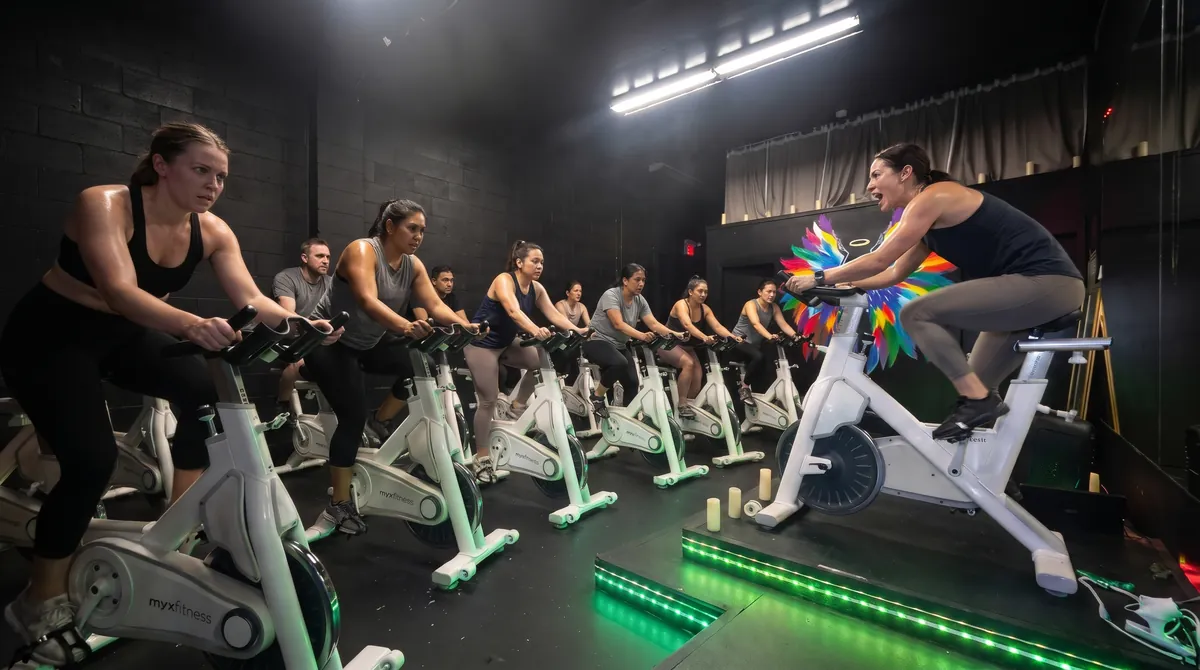
A coached indoor class is one way to keep riding through a wet Nanaimo winter. It is not structured power training built on measured watts. What it gives a cyclist is climbs and intervals at set times, with easy rides at talk pace between them.
Picture a wet Sunday at 9:00 am, when you would have been rolling out. The class is Intervals. The coach greets each rider by name, and the bikes are set. The warm up builds to effort six, with two short pick-ups. From minute 28 comes the last block: twenty seconds at effort ten, forty seconds easy, eight times over.
This page is for people who already ride outside. It covers what a winter off the bike costs, what research says about hard and easy riding, and what a class can and cannot do.
What happens when a cyclist stops for the winter?
Fitness slips, and long breaks cost more than short ones. A 2022 review from South China Normal University pooled 21 studies of trained people who stopped training. It measured maximal oxygen uptake, a standard test of aerobic fitness. The measure fell after breaks shorter than four weeks, and fell more after longer ones.
The same review found a way to soften the loss. Doing some exercise during the break weakened the effect. Its advice to athletes is to keep doing some physical exercise while regular training is stopped.
That sets a modest goal for the wet months: keep something going. Winter in Nanaimo has the rain numbers. Indoor cycling or riding outside covers traffic, lights and the dry season.
Hard intervals and easy riding both have a place
Two reviews describe how trained riders use each.
A 2024 review published by the International Universities Strength and Conditioning Association looked at trained cyclists aged 18 to 49. It compared interval training with continuous riding at low to moderate intensity. Interval training led to small improvements across all the measures combined. The studies ran two or three interval sessions a week.
Easy riding matters too. A 2015 review from the universities of Salzburg and Würzburg gathered studies of how competitive endurance athletes spread their effort. Most of those studies showed a high proportion of high volume, low intensity training.
Both reviews studied trained athletes on full programs, not a class. Read them as a frame. Together they describe a week with some hard riding and a good deal of easy riding.
Our week has both kinds. Seven rides are a level 3, and 24 stay at talk pace. On HealthLink BC's scale of 0 to 10, vigorous effort is a 7 or 8. Its examples include riding a bike fast or on hills.
What does a class here give a cyclist?
| What you want | The ride | The honest limit |
|---|---|---|
| Climbing | Hills, Tuesday and Thursday at 5:30 pm: three hills, seated then standing, resistance up every minute | 45 minutes, with resistance in place of a real gradient |
| Hard efforts | Intervals, Monday, Wednesday and Friday at 6:00 am, and Sunday at 9:00 am: bursts at effort eight, nine, then ten | Effort is called by feel, not in watts |
| Easy riding | 24 rides a week at talk pace, most of them an hour | An hour, not a long day in the saddle |
| Company | Thirteen bikes and a coach who knows your name | No pace line, no cornering, no descents |
The coach calls the effort in every ride, and you set your own resistance. Intervals on a bike walks through the three blocks. What talk pace means explains the easy rides.
Stronger every climb.
The coach, at minute 32 of Hills
A class is not a power plan
Be clear about what you are booking.
- Effort is called by feel. The coach uses a scale of 1 to 10, and talk pace. If your plan depends on measured watts, keep that work on your own trainer.
- The ride is short. A level 3 runs 45 minutes, and the main work lasts 24. It does not stand in for a long ride.
- It is not your bike. The bikes are MYX II bikes, and a coach sets yours to you before your first ride. Every pedal has a cage. Clip in if you have cycling shoes, and bring runners the first time, in case your cleats do not suit the pedal.
- Your first three rides are a 1 or a 2. That holds however fit you are. Hills and Intervals start at ride four.
- Skills stay outside. No class teaches balance, cornering or riding near traffic.
If you already train indoors at home, you own a bike at home, so why ride here? is the page for you. Runners get the same treatment in spin or running through a Nanaimo winter. Heading for the snow as well? See ski season legs.
Riding at 85 Cliff Street
You do not need a membership to ride through the wet months. A single drop in is $28, or $20 for students with valid student ID. Cancel up to two hours before any class and your credit comes back, so a dry morning costs you nothing.
Every class and when it runs sits on one page, and spin classes in Nanaimo lists every room in town.
Every class is included in a membership. The founding 50 pay $68 every two weeks or $149 a month, held while the membership stays continuous. After them, it is $87 every two weeks or $189 a month. The studio is at 85 Cliff Street, Nanaimo, and booking opens with the doors on Tuesday, December 1.
Questions people ask
Is a spin class good winter training for cyclists?
It keeps you riding hard and easy on set days through the wet months. It is not structured power training, and it does not replace long rides outside.
Can I train with power in a class?
The coach calls effort on a scale of 1 to 10 and by talk pace, not in watts. If your plan depends on measured power, keep that work on your own trainer.
Which class is closest to climbing?
Hills. It runs Tuesday and Thursday at 5:30 pm: three hills, seated then standing, with resistance up every minute. It lasts 45 minutes.
Can I bring my cycling shoes?
Yes. Every pedal has a cage, so any runner works, and you can clip in if you have cycling shoes. Bring runners the first time, in case your cleats do not suit the pedal.
Do I have to join for the whole year?
No. A drop in is $28 a ride with no membership, and members get one free pause of up to a month each year.
Sources
- BioMed Research International, Effects of Short- and Long-Term Detraining on Maximal Oxygen Uptake in Athletes: A Systematic Review and Meta-Analysis, from South China Normal University, Published August 16, 2022, read November 21, 2026
- International Journal of Strength and Conditioning, Physiological and Performance Adaptations to Interval Training in Endurance-Trained Cyclists, record in the Liverpool John Moores University research repository, Published 2024, deposited November 13, 2024, read November 21, 2026
- Frontiers in Physiology, The training intensity distribution among well-trained and elite endurance athletes, from the University of Salzburg and the University of Würzburg, Published October 27, 2015, read November 21, 2026
- HealthLink BC, Physical activity definitions, Last updated December 1, 2016, read November 21, 2026