
What to look for in a spin coach
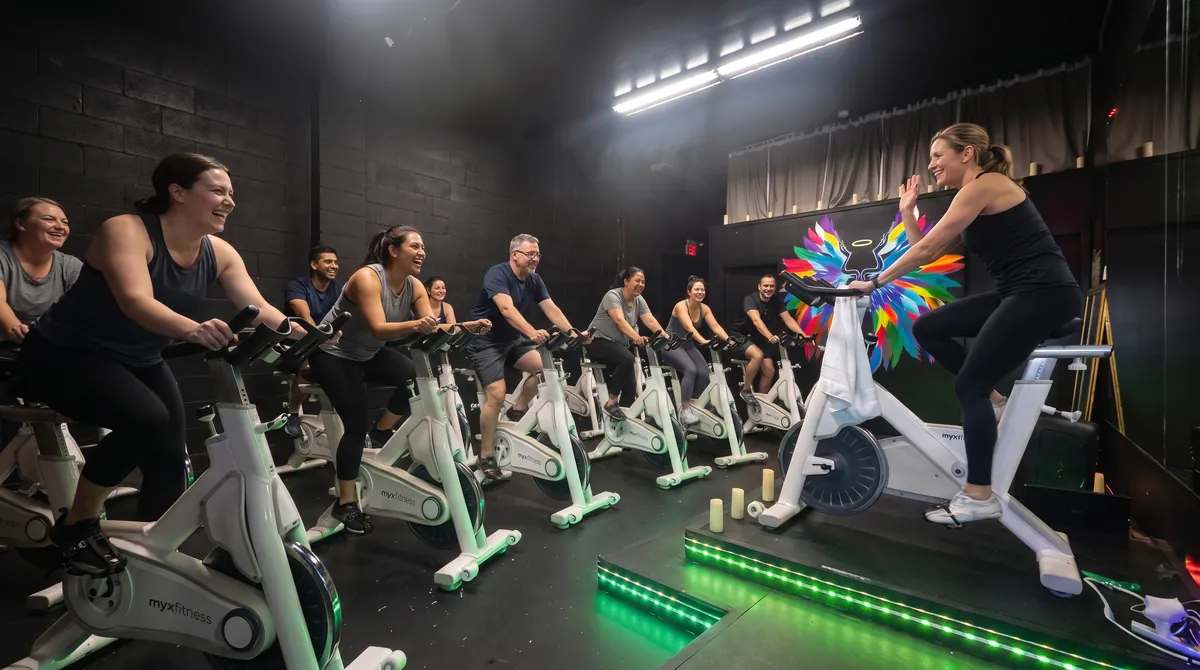
A good spin coach learns your name, sets your bike before you ride, and labels how hard the class is before you book. In the room, a good coach gives each cue once, lets you ride, and says the easier option out loud.
Picture minute 18 of a Grounding ride at 85 Cliff Street. The first seated climb begins, heavy and slow. The coach says one line, once: half resistance on the climbs is fine. Then the coach goes quiet, and the music carries the room.
This page covers what a good coach does, what one study of group exercise found about instructors, and how each point shows up in our room.
What does a good spin coach do?
| What to look for | How it shows up in our room |
|---|---|
| Knows your name | Greets every rider by name at the door, and says goodbye by name at the end |
| Sets you up before you ride | A bike check for new riders, and a private 20 minute fit for founding members |
| Tells you how hard it will be | A level on every class before you book: 1 easy, 2 moderate, 3 intense |
| Cues once, then goes quiet | One prompt in the quiet minute, said once, and short theme moments |
| Says the easier option out loud | Half resistance on the Grounding climbs, and any Intervals burst can be sat out |
| Keeps you safe | In Visualization, eyes stay open while the pedals turn |
| Asks before using your name | In Your Song, a rider's first name is said only if they said yes |
None of these needs a famous name or a big voice. Each one is a habit, and you can spot it in the first ten minutes.
A good coach cues once, then goes quiet
Too much talking turns a ride into a lecture. Our coaches keep it short. After the greeting, there is one minute of silence and one prompt, said once. The warm up has no cues except breath.
During the ride, the class theme is spoken in three short moments, 30 to 60 seconds each. The rest of the hour belongs to the music, your breath and the bike. In Breathwork, the coach teaches the pattern in the warm up, counts three rounds, then goes quiet.
Some rides need more voice, and a good coach knows which. In Morning Rave, the coach talks through the class, calls each drop and cheers people on. Even there, the music leads.
A good coach says the easier option out loud
A coach who never offers an easier way is asking you to keep up. A good one offers it once, plainly, so nobody has to ask.
In Grounding, the gentle option is half resistance on the climbs, said once at minute 18. In Intervals, effort is called on a 1 to 10 scale, and anyone can sit out any burst and ride easy. In Your Song, the tempo of a song never sets the effort. The coach does.
You set your own resistance in every class, so the hour is never harder than you choose. Your first three rides are always a 1 or a 2. How hard each level is explains the labels, and do you have to stand in a spin class? covers the climbs.
We believe in you until you believe in yourself.
The first line on the studio's home page
What does research say about instructors?
Researchers at the Université du Québec à Montréal studied 463 adults in group exercise courses in Quebec, and interviewed 11 of them. In the interviews, people valued instructors who explained and showed the moves, corrected them when needed and offered variety. They also valued instructors who remembered names and injuries, built social connections, and found a different exercise when someone could not do one.
The numbers told a quieter story. How people saw an instructor's appearance and competence did not predict whether they re-enrolled. The social climate of the group did. The authors suggest instructors can help by promoting social exchange and bringing new people into the group in the first few weeks.
That fits a small room. With thirteen bikes, the coach knows every name by the first climb. How big a spin class should be covers the room itself.
What is missing from our list on purpose
There is no leaderboard, and nobody is ranked. We still ask you to push: not to keep up with anyone, but to find out what you can do. Why there is no leaderboard explains the choice.
There is no shouting either. If you only show up when someone shouts, the home page says it plainly: nobody here will. The coach is at the door when you arrive, and at the door again when you leave.
Meet the coaches at 85 Cliff Street
Every class runs the same shape, so any coach can run it the same way and you always know what comes next. A coach fits your bike and rides with you before your first class. Your first spin class, minute by minute walks through the hour.
Every class is included in a membership. The founding 50 pay $68 every two weeks or $149 a month, held while the membership stays continuous. After them, membership is $87 every two weeks or $189 a month. A single drop in is $28, or $20 for students with valid student ID. Booking opens with the doors on Tuesday, December 1, and every class and when it runs is on one page.
Questions people ask
Should a spin coach know my name?
In a small room, yes. Ours is capped at thirteen bikes so the coach knows every name, greets you at the door and says goodbye there too.
Will the coach shout at me?
No. The home page says it plainly: if you only show up when someone shouts, nobody here will. On the level 3 days, the coach cheers the room on.
What if I cannot keep up?
You set your own resistance in every class. In Grounding the coach offers half resistance on the climbs, and in Intervals anyone can sit out any burst.
Who sets up my bike?
A coach sets your bike at the door before your first ride. Founding members get a private 20 minute fit, with their bike numbers written in a workbook.
Sources
- BMJ Open Sport and Exercise Medicine, Perceptions of group exercise courses and instructors among Quebec adults, Published December 7, 2017, read November 17, 2026