
Spin classes over 40 in Nanaimo
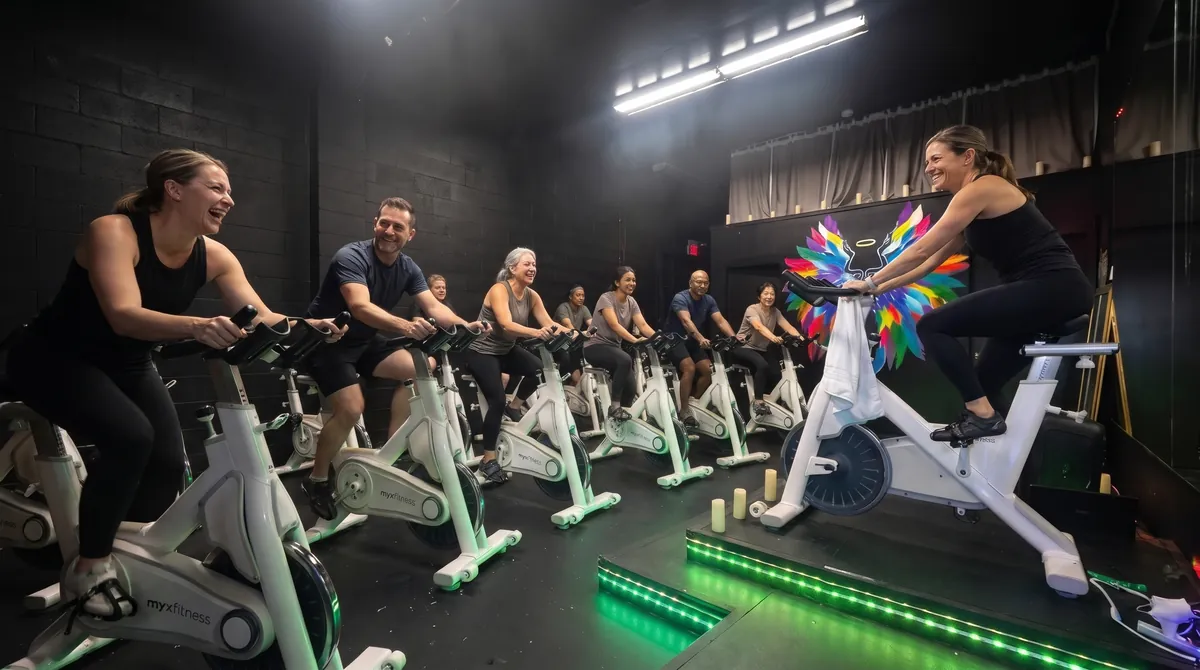
A spin class can suit you after 40, and you do not need to be fit to start. Twenty four of our 31 weekly rides in Nanaimo stay at talk pace. You set your own resistance, and your first three rides are a 1 or a 2.
It is 5:30 on a Wednesday at 85 Cliff Street. The coach greets you by name and asks for one intention, kept to yourself. The warm up is seated and builds to talk pace. At minute 27 the road tilts into one heavy, slow climb, and from minute 32 standing is optional. The hour ends seated on the bike, pedals still.
This page covers what Statistics Canada measured in adults aged 40 to 59, what Canadian gynaecologists say about exercise in perimenopause, and where to start.
How active are Canadians in their 40s and 50s?
About half reach the national target. Statistics Canada's Canadian Health Measures Survey put a number on it for 2018 and 2019. It found that 52 percent of adults aged 40 to 59 accumulated at least 150 minutes a week of moderate to vigorous activity.
| Age group | Share reaching 150 minutes a week, 2018 and 2019 |
|---|---|
| 18 to 39 | 58 percent |
| 40 to 59 | 52 percent |
| 60 to 79 | 33 percent |
Its October 2026 update followed the trend from 2007 to 2024. The share of 40 to 59 year olds meeting the recommendation rose slightly over that time. Across all adults, 46 percent met it.
The 150 minutes come from Canada's 24-Hour Movement Guidelines for adults aged 18 to 64. The guidelines add that progressing towards any target brings some health benefits. You do not have to reach it in week one.
Does exercise help in perimenopause?
Canadian gynaecologists say it does, within limits. The Society of Obstetricians and Gynaecologists of Canada says most people experience the changes of perimenopause in their 40s or early 50s.
On its page about exercise, the society says research shows regular exercise delivers physical and emotional benefits to women dealing with the symptoms of menopause. It names less stress and a general feeling of well-being among them.
The same page gives two pieces of advice. If you have not been exercising regularly, start slowly and build up. And build a balanced program, with weight-bearing exercise such as brisk walking or weight training, plus stretching.
A ride is exercise, not a treatment for symptoms. It is one part of that balanced program, and the next section shows which part.
A ride covers the aerobic minutes, not the whole week
Here is what the guidelines ask for, beside what a ride gives you.
| What the guidelines ask of adults 18 to 64 | What a ride here covers |
|---|---|
| At least 150 minutes a week of moderate to vigorous aerobic activity | 27 minutes of main ride in an hour class, 24 in a 45 minute class |
| Muscle strengthening at least twice a week | Not covered. Plan it elsewhere in your week |
| Several hours of light activity, standing included | An easy level 1 ride can count here |
| 7 to 9 hours of sleep | Not covered |
A ride is seated, so it is not weight-bearing either. Arthritis Society Canada says cycling puts much less load through the hip, knee and ankle, because your weight is supported on a seat. That is kind to sore joints. It also means the walking and the weights still matter.
Is spin low impact? covers knees and coming back after a break. How many rides a week shows how the minutes add up.
Start at talk pace, then add one climb
Starting slowly has a shape here. Every class carries a number, so you know how hard it is before you book.
Level 1 is a full sentence the whole way, and nobody stands. Fourteen rides a week sit there: Grounding, Breathwork and Your Song. Level 2 keeps talk pace and adds heavy, slow climbs. Ten rides a week sit there: Intention Journey, Visualization and Sunday Service. Level 3 goes past talk pace, and it is labelled so you never walk into one by accident.
Your first three rides are always a 1 or a 2, and a coach sets your bike at the door. Nobody is watched, and there is no leaderboard. Spin class for beginners walks through a first hour.
You want to feel strong and calm, and somewhere to belong while you do it.
Our home page, under who this is for
If you are past 50, spin classes over 50 covers the guidelines after 65 and the noon rides.
Riding at 85 Cliff Street
The studio is at 85 Cliff Street, Nanaimo, and every class and when it runs sits on one page. Every class is 19 and over, and every pedal has a cage, so any runner works.
There is a guarantee. Ride for 30 days, and if you do not feel calmer, stronger or more at home, we refund the month.
Every class is included in a membership. The founding 50 pay $68 every two weeks or $149 a month, held while the membership stays continuous. After them, it is $87 every two weeks or $189 a month. A single drop in is $28, or $20 for students with valid student ID. Booking opens with the doors on Tuesday, December 1.
Questions people ask
Am I too old to start spin at 40 or 45?
No. Every class is open to adults 19 and over, and most of the week rides at talk pace. Your first three rides are always a 1 or a 2.
I have not exercised in years. Where do I start?
With a level 1: Grounding, Breathwork or Your Song. You stay seated, you set your own resistance, and a coach sets your bike at the door.
Is a spin class enough exercise on its own?
It covers aerobic minutes, not strength. Plan muscle strengthening somewhere else in your week, as Canada's movement guidelines ask.
Will a ride help with perimenopause symptoms?
Canadian gynaecologists say regular exercise brings physical and emotional benefits to women dealing with menopause symptoms. A ride is exercise, not a treatment.
What if I try it and it is not for me?
Ride for 30 days. If you do not feel calmer, stronger or more at home, we refund the month.
Sources
- Statistics Canada, The Daily: Canadian Health Measures Survey, Activity monitor data, 2018-2019, Published September 1, 2021, read November 19, 2026
- Statistics Canada, The Daily: Health Reports, October 2026, Trends in physical activity among Canadian adults from 2007 to 2024, Published October 21, 2026, read November 19, 2026
- Canadian Society for Exercise Physiology, Canadian 24-Hour Movement Guidelines for Adults aged 18 to 64 years, Published October 27, 2020, updated April 6, 2026, read November 19, 2026
- Society of Obstetricians and Gynaecologists of Canada, Menopause and U: What is menopause?, Published April 19, 2018, updated October 8, 2025, read November 19, 2026
- Society of Obstetricians and Gynaecologists of Canada, Menopause and U: Exercise and an active lifestyle, Published April 19, 2018, updated August 26, 2025, read November 19, 2026
- Arthritis Society Canada, Osteoarthritis, including low load activities for osteoarthritis, Published September 3, 2025, updated August 7, 2026, read November 19, 2026