
Does spin build muscle and glutes?
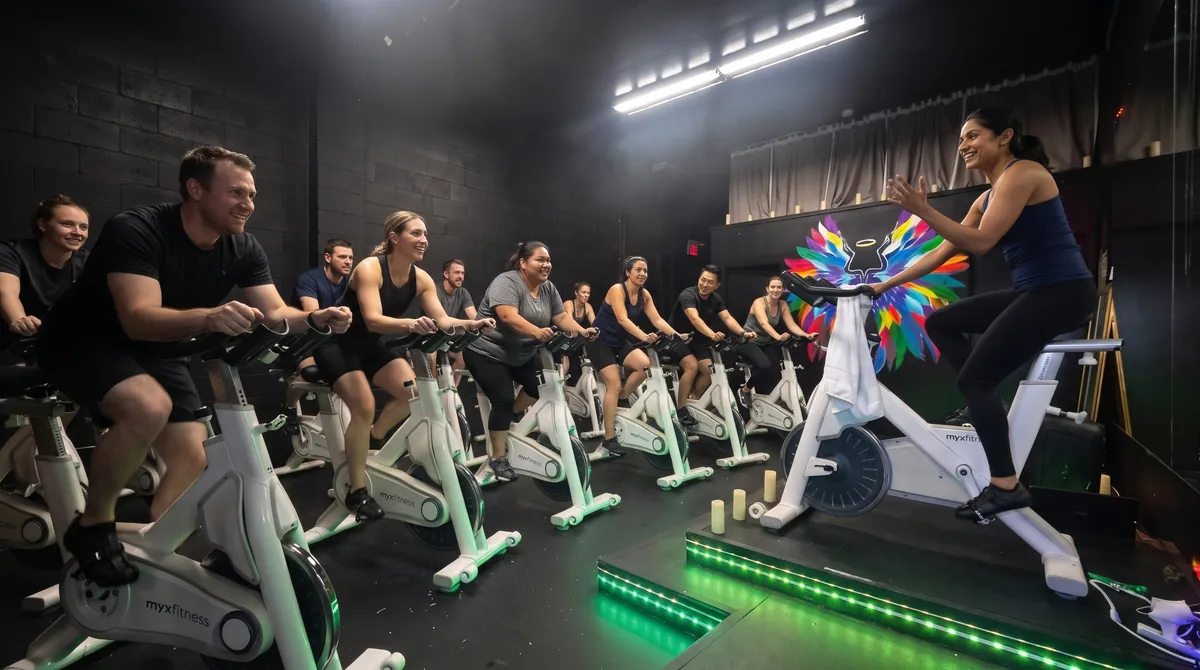
Partly. Pedalling uses your glutes and thighs, and a research review found cycling programs can grow thigh muscle in adults who were not active. It is not strength training, though. Canada's guidelines ask for muscle strengthening at least twice a week on top of aerobic activity.
Picture minute 12 of Hills on a Tuesday evening. The first hill is six minutes seated, and the resistance goes up every minute. Then comes one minute standing, and one minute easy. Three hills later the pedals stop, and the coach says one line: feel what your legs just did.
This page covers which muscles a ride uses, what research found about cycling and muscle size, what a ride leaves out, and where the climbs are.
Which muscles does a spin class use?
Mostly the ones from the hips down. A University of Cape Town study of pedalling lists the muscles most often studied in cycling. They are the gluteus maximus, three muscles of the quadriceps, one hamstring, one calf muscle and one shin muscle.
The gluteus maximus and the hamstring act as hip extensors, the study says. The three quadriceps muscles extend the knee. So the glutes do work on a bike, along with the front and back of the thigh.
All seven are lower limb muscles. Arms, chest and upper back are not on the list.
Does cycling make muscle bigger?
It can, in people who start from little. Researchers at the Mayo Clinic College of Medicine and Taylor University reviewed the studies. They found growing evidence that aerobic training can grow muscle in sedentary people aged 20 to 80. Over 70 percent of the studies that used a stationary bike saw an increase in muscle. The growth showed in the muscles used most, and the studies measured the thigh.
The programs were not casual. The review says the effect most likely depends on enough intensity, duration and frequency. It gives 30 to 45 minutes, four to five days a week, at 70 to 80 percent of heart rate reserve. In the authors' own studies, people cycled for 12 weeks.
Most rides here are gentler than that on purpose. Talk pace is an easy to moderate effort, and the main ride lasts 24 or 27 minutes.
Two limits are worth knowing. The review reports no measurement of the glutes. And growth was not found in every study.
Resistance training still does more. A team led from Victoria University in Melbourne compared the two across 21 studies. Aerobic training on its own, they concluded, does not promote the same muscle growth as resistance training. Their figures were for the front of the thigh.
A ride is not strength training
Canada's 24-Hour Movement Guidelines list two separate things for adults aged 18 to 64. One is at least 150 minutes a week of moderate to vigorous aerobic activity. The other is muscle strengthening, using major muscle groups, at least twice a week.
A ride sits on the first line. Arthritis Society Canada says cycling builds leg muscle strength and endurance, and that is as far as the claim goes. Every class here happens on a bike. There are no mats and no floor work, so plan strength for the rest of your body somewhere else in the week.
| Question | What the research found | Who or what it studied |
|---|---|---|
| Does pedalling use the glutes? | Yes. The gluteus maximus acts as a hip extensor | A lab study of cycling muscles |
| Can cycling grow thigh muscle? | In most studies, on a demanding schedule | Sedentary adults aged 20 to 80 |
| Does it match resistance training? | No. Resistance training grew more | 21 studies of the front of the thigh |
| Does a ride count as muscle strengthening? | The guidelines list that separately | Adults aged 18 to 64 |
Sore after a spin class covers how your legs feel the day after, and how many rides a week shows how the aerobic minutes add up.
The climbs are where the legs do the most
If stronger legs are what you want from a ride, look for resistance. You set your own in every class, so any climb is as heavy as you make it.
- Level 1. Grounding has three seated climbs, heavy and slow.
- Level 2. Talk pace with heavy, slow climbs. Ten of these rides run each week.
- Level 3. Hills is three hills, seated then standing, with resistance up every minute. It runs Tuesday and Thursday at 5:30 pm.
Your first three rides are always a 1 or a 2, so Hills waits until ride four. How hard each level is sets the three numbers side by side.
Feel what your legs just did.
The coach, as Hills comes to rest
For work away from the bike, spin or CrossFit and spin or reformer Pilates each set a ride beside another kind of class. Spin or weight training explains why a week needs both.
Riding at 85 Cliff Street
Every class and when it runs sits on one page, and every place to ride in Nanaimo lists the other rooms in town. Two of them pair a ride with strength in the same class.
Every class is included in a membership. The founding 50 pay $68 every two weeks or $149 a month, held while the membership stays continuous. After them, it is $87 every two weeks or $189 a month. A single drop in is $28, or $20 for students with valid student ID. The studio is at 85 Cliff Street, Nanaimo, and booking opens with the doors on Tuesday, December 1.
Questions people ask
Does spin class build muscle?
Partly. A research review found cycling programs can grow thigh muscle in adults who were not active. Canada's guidelines still list muscle strengthening separately, at least twice a week.
Is spin class good for glutes?
Pedalling uses them. A University of Cape Town study lists the gluteus maximus among the main cycling muscles, acting as a hip extensor. The growth studies we read measured thighs, not glutes.
Do I still need strength training if I ride?
Canada's guidelines ask adults for muscle strengthening with the major muscle groups at least twice a week, alongside aerobic activity. A ride covers the aerobic part.
Which class has the most climbing?
Hills, a level 3: three hills, seated then standing, with resistance up every minute. Your first three rides are a 1 or a 2, so it waits until ride four.
Sources
- Exercise and Sport Sciences Reviews, Skeletal Muscle Hypertrophy after Aerobic Exercise Training, Published April 2014, read November 21, 2026
- Canadian Society for Exercise Physiology, Canadian 24-Hour Movement Guidelines for Adults aged 18 to 64 years, Published October 27, 2020, updated April 6, 2026, read November 21, 2026
- Sports Medicine and Health Science, Muscle recruitment patterns and saddle pressure indexes with alterations in effective seat tube angle, Published October 23, 2021, read November 21, 2026
- Sports Medicine, Does Aerobic Training Promote the Same Skeletal Muscle Hypertrophy as Resistance Training? Accepted manuscript, Victoria University Research Repository, Published 2018, read November 21, 2026
- Arthritis Society Canada, Osteoarthritis, including low load activities for osteoarthritis, Published September 3, 2025, updated August 7, 2026, read November 21, 2026